If you buy live plants from another country, the shipment needs a phytosanitary certificate. Without one, customs at your border can hold the parcel, send it back, or destroy the plants. This guide explains what the certificate is, who issues it in Indonesia, what it contains, and what you still need to check on your side as the buyer.
Short answer: a phytosanitary certificate is an official export document. Indonesia’s quarantine authority issues it after inspecting the plants, and it states that they are free of regulated pests and meet your country’s import rules. For every Labijo export order we apply for the certificate on your behalf, and it is included free.
What is a phytosanitary certificate?

A phytosanitary certificate is issued by the national plant protection organization (NPPO) of the exporting country. Its format follows the International Plant Protection Convention (IPPC) and the international standard ISPM 12, so plant inspectors in any country read it the same way.
The certificate confirms that the plants, cuttings or plant products in the shipment were inspected, are considered free from quarantine pests, and conform to the phytosanitary import requirements of the destination country.
Who issues it in Indonesia?
In Indonesia the certificate is issued by the Indonesian Quarantine Authority (Badan Karantina Indonesia, often shortened to Barantin). Before 2023 this work belonged to the Agricultural Quarantine Agency of the Ministry of Agriculture, which is why older documents carry that name.
A quarantine officer inspects the plants before they leave the country. Depending on the destination, the plants may also need a treatment, such as washing all soil off the roots, before the officer signs and stamps the certificate.
What is the certificate for?

Pests and plant diseases travel easily with live plants. The certificate protects farms, gardens and wild plants in the importing country by showing that the shipment was checked at the source. For you, it is the document that lets the plant inspectors at your border clear the parcel instead of rejecting it.
When do you need one?

Almost every country requires a phytosanitary certificate for live plants for planting, including small parcels sent by courier. A few common destinations:
- United States: plants for planting need a phytosanitary certificate. USDA itself only asks for an import permit (PPQ 587) for 13 or more plants, but Indonesia’s quarantine authority requires the buyer’s permit before it issues a certificate for any US shipment. So every US order from Labijo needs a permit, and orders of 13 or more plants go through a USDA plant inspection station first. Read our guide to shipping plants into the US.
- European Union: since December 2019 all plants for planting entering the EU need a phytosanitary certificate, even a single plant.
- United Kingdom: live plants need a phytosanitary certificate, and the importer usually has to pre-notify the shipment.
- Australia and New Zealand: the rules are very strict. Many species need an import permit and post-entry quarantine, and some cannot be imported at all.
Fresh rhizomes such as black ginger, fruit tree seedlings and some herbs need a certificate too. Soil is restricted almost everywhere, so live plants usually travel bare-root or in clean sphagnum moss where that is allowed. Rules differ by country and change over time, so check your national plant protection organization before you order.
What information is on the certificate?
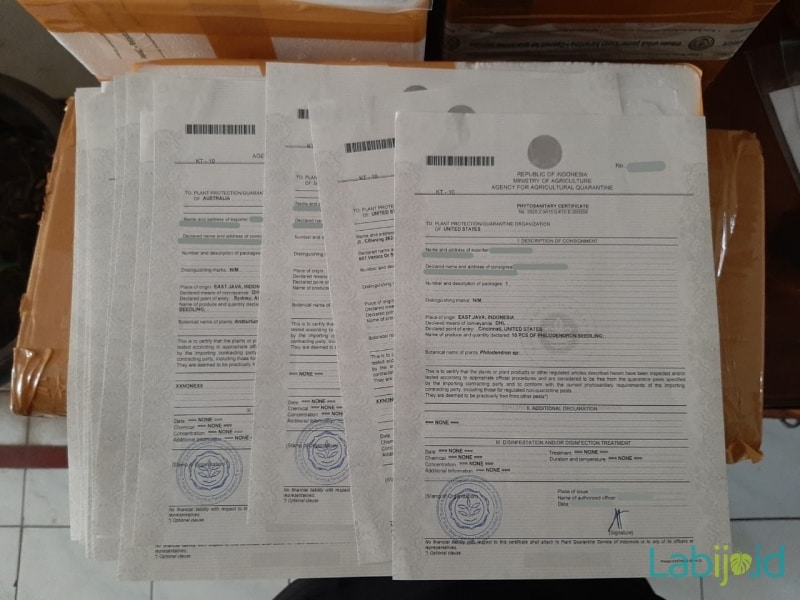
- Name and address of the exporter and of the consignee (you)
- Place of origin, means of conveyance, and declared point of entry
- Number and type of packages, and any distinguishing marks
- Botanical name and quantity of every plant or product in the shipment
- Additional declarations that your country requires, if any
- Treatment details: date, treatment type, chemical and concentration, duration and temperature
- Certificate number, place and date of issue, and the signature and stamp of the authorized officer
How long does it take?
For Labijo orders, export document processing takes about 7 to 14 business days. That covers preparing the plants, the quarantine inspection and issuing the certificate. Once the certificate is ready, the plants are packed and shipped, and delivery time depends on the distance from Indonesia: to Singapore it is usually 2 to 3 days, and to the US or Europe about a week, plus any time in customs.
What you need to check as the buyer
- Check that your country allows the species you want. Some rare plants are protected under CITES or banned outright.
- If your country needs an import permit, get it first and send it to us before we apply for the certificate. Some permits ask for specific declarations on the certificate.
- Give us the exact consignee name and address. They must match the shipping label and the customs documents.
- Keep the copy of the certificate we send you until the parcel has cleared customs.
Frequently asked questions
Do I pay for the phytosanitary certificate at Labijo?
No. We apply for the certificate and cover its cost on every export order.
Is a phytosanitary certificate the same as an import permit?
No. The certificate comes from the exporting country, which is Indonesia. An import permit, when your country needs one, comes from your own government, and you apply for it as the buyer.
Can a parcel still be refused if it has a certificate?
Yes. Inspectors at your border can still open the parcel, and they can treat, return or destroy it if they find pests, soil or a species that needs a permit. A correct certificate makes that much less likely. See also how to buy and import plants from Indonesia.
Ready to order? Browse the Labijo catalog or send us your wishlist. The certificate is on us.
