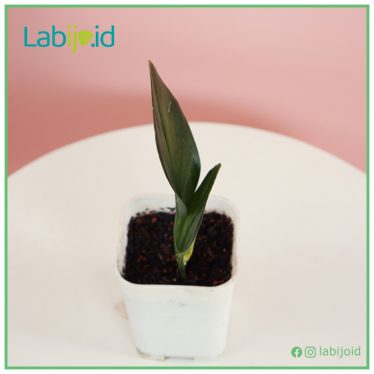
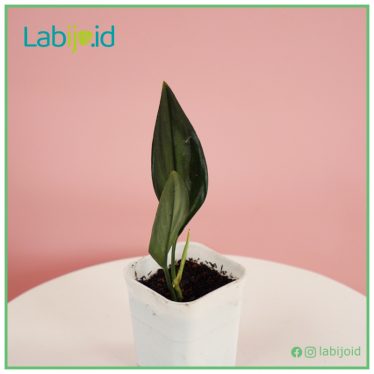
Scindapsus treubii Dark Form has thick, glossy leaves so dark green they look almost black. It is a slow, compact climber from Southeast Asia and one of the easiest rare aroids to keep: it tolerates lower light than most and tells you clearly when it needs water.
This guide covers Treubii Dark Form in detail, and the basics that apply to every scindapsus, from Treubii Moonlight to the satin pothos varieties.
Scindapsus treubii Dark Form at a glance
- Botanical name: Scindapsus treubii ‘Dark Form’ (Araceae)
- Origin: species native to Southeast Asia
- Light: medium to bright, indirect
- Water: when most of the soil has dried; leaves curl slightly when thirsty
- Humidity: 50% or higher
- Temperature: 18–30 °C (65–86 °F); keep it above 15 °C (59 °F)
- Growth: slow; climbs and makes larger leaves on a pole or board
- Toxicity: contains calcium oxalate; keep away from pets
Light
Treubii Dark Form does well in medium to bright, indirect light, for example near an east-facing window or a little back from a bright one. It copes with lower light than most aroids but grows very slowly there. Direct midday sun bleaches and scorches the leaves.
Soil
Use a chunky, fast-draining mix: houseplant mix with plenty of perlite and orchid bark, or an aroid mix. In nature scindapsus climb tree trunks, so the roots like air; a dense, wet soil leads to root rot.
Watering
Let most of the soil dry before watering, then water thoroughly and let it drain. Scindapsus give a clear signal: when the leaves start to curl inwards slightly, it is time to water. Do not wait until they curl strongly every time, as repeated stress slows growth. Hard tap water can leave white marks on the dark leaves; rainwater or filtered water avoids that.
Humidity, temperature and feeding
Keep humidity at 50% or higher and the temperature between 18 and 30 °C. Feed with a balanced liquid fertiliser at half strength once a month in the growing season.
Climbing and propagation
Treubii Dark Form grows larger, more mature leaves when it can climb a moss pole or a wooden plank, where the leaves lie flat against the support. To propagate, take a stem cutting with at least one node and root it in water, moist sphagnum or a light mix; it roots slowly, often in four to six weeks.
Caring for other scindapsus
The same care works for the whole genus. The main differences are light and growth speed:
- Scindapsus treubii Moonlight: silvery leaves, same care as Dark Form
- Scindapsus pictus (satin pothos, such as Exotica, Silvery Ann and Jade Satin): faster growing, needs bright indirect light to keep its silver pattern
- Scindapsus lucens: a separate species with dark, velvety leaves
- Variegated forms (Jade Satin variegated, Tricolor): brighter light, a little more care with watering
Note that the popular ‘N’Joy’, ‘Marble Queen’ and ‘Golden’ pothos are Epipremnum, not scindapsus, although they are cared for in much the same way.
Common problems
- Curling leaves: the plant is thirsty; water thoroughly.
- Yellow leaves and soft stems: overwatering or a mix that stays wet; check the roots for rot.
- Very slow growth or small leaves: too little light, or no support to climb.
- White cottony tufts or fine webbing: mealybugs or spider mites; see how to protect indoor plants from pests.
Frequently asked questions
Is Scindapsus treubii Dark Form rare?
It is less common than satin pothos but no longer extremely rare; availability depends on what growers have ready.
Why are my Scindapsus leaves curling?
Usually thirst. Water thoroughly and the leaves flatten within a day. If the soil is wet and the leaves still curl, check the roots for rot.
Is scindapsus the same as pothos?
No. Pothos is Epipremnum; scindapsus is a related genus with thicker, often silvery or very dark leaves. Care is similar.
Current availability is shown on the Scindapsus treubii Dark Form product page; see also all scindapsus in our catalog.
Buying for a plant shop? Labijo grows and exports Scindapsus treubii Dark Form and 1,000+ other tropical species from Indonesia, with the phytosanitary certificate included. Wholesale pricing, 25% below the catalog price, starts at 20 plants of one species or 100 plants mixed. See our wholesale Scindapsus plants or browse the full wholesale tropical and rare plant catalog.
