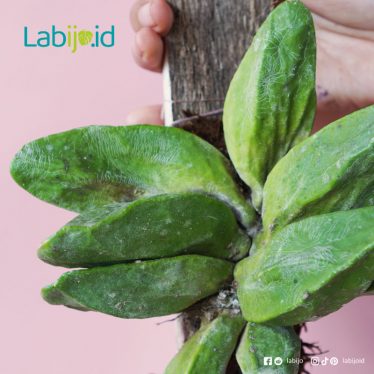
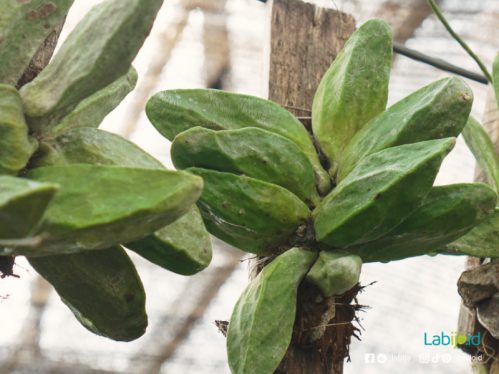
Dischidia major is an epiphytic climber in the dogbane family (Apocynaceae) and a close relative of hoyas, which is why it is sometimes sold as “Hoya major” or “banana hoya”. Its best-known feature is the hollow pouch leaves. In the wild, ants nest inside them, and the plant grows roots into the pouches to take up nutrients from the debris the ants leave behind. That habit gives it its other common names: ant plant and rattle skulls.
It is not a beginner plant, but it is not difficult either once you understand one thing: it lives on tree bark, not in soil, so most problems come from too much water and too little air around the roots.
Dischidia major at a glance
- Botanical name: Dischidia major (Apocynaceae)
- Common names: ant plant, rattle skulls, sometimes sold as Hoya major
- Native range: tropical Asia, from northeast India through Southeast Asia to northern Australia
- Habit: epiphytic climber or trailer with small flat leaves and larger hollow pouch leaves
- Light: bright, indirect
- Humidity: 50% minimum, 60–80% is ideal
- Watering: let the medium dry slightly between waterings
- Growth: slow to moderate
Light
In nature Dischidia major grows on tree trunks under the forest canopy, in bright but filtered light. Indoors, a spot near an east or west window behind a sheer curtain works well. Direct midday sun turns the leaves yellow and then brown. Too little light makes the stems stretch and the plant stops forming pouches. Under a grow light, 10–12 hours a day is enough.
Growing medium or mount
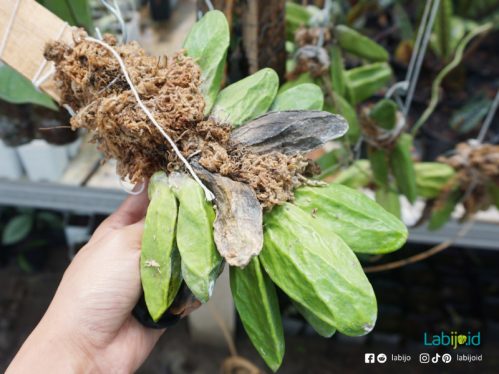
Dischidia major needs a medium that holds a little moisture and drains immediately. In our nursery we grow it in sphagnum moss. At home you can use sphagnum, a coarse orchid mix of bark, coco chips and charcoal, or mount the plant on cork or a tree fern slab. Avoid regular potting soil: it stays wet around the roots and causes rot.
Watering
This is where most plants are lost. Water when the medium is almost dry, then let it drain completely. The flat leaves are a good guide: when they feel soft and slightly wrinkled the plant needs water; when they feel firm it does not. Mounted plants dry faster and may need water every few days in warm weather, potted plants much less often.
A fine spray reaches the roots and the inside of the pouches better than a heavy pour. Never leave water standing in the pot or the pouches for days. Stems that turn dark and mushy are a sign of rot: cut them back to healthy tissue and let the medium dry out more between waterings.
Humidity and air
Keep humidity above 50%, ideally 60–80%. Below that the plant grows more slowly and older leaves may yellow. Good air movement matters as much as humidity: a stuffy, wet corner invites rot. A bright bathroom, a cabinet with a small fan, or grouping plants together all help.
Feeding
Indoors there are no ants to feed the plant, so a little fertiliser helps. Use a balanced fertiliser at a quarter of the label strength about once a month while it is actively growing, and skip it when growth slows. Too much fertiliser burns the fine roots.
Ants, pests and flowers
You do not need ants to grow Dischidia major indoors. Mealybugs are the most common pest and like to hide inside the pouches, so check there when you water. Wipe them off with a cotton bud dipped in rubbing alcohol, or treat with insecticidal soap. Mature plants produce small waxy flowers in clusters at the leaf nodes.
Propagation
Take stem cuttings with at least two or three nodes and lay them on moist sphagnum moss in a covered container. Roots usually appear in a few weeks. Keep the cuttings warm, bright and humid until they start to grow.
When your plant arrives
Our plants travel bare-root, with the roots wrapped in moss. Unpack them on the day they arrive, settle them into slightly moist sphagnum and keep them humid and out of direct sun for the first two to three weeks. A plant that looks a little soft after the trip usually firms up within days. Our guide on helping plants recover after shipping covers the first week step by step.
Frequently asked questions
Is Dischidia major a hoya?
No. It belongs to the related genus Dischidia in the same family (Apocynaceae). Sellers sometimes call it Hoya major or banana hoya, but the botanical name is Dischidia major.
Does Dischidia major need ants?
No. In the wild ants live in the pouch leaves and feed the plant, but indoors it grows well without them if you give it a light feed during the growing season.
Why is my Dischidia major turning black?
Black, soft stems and leaves almost always mean too much water or a medium that stays wet. Cut away the affected parts, move the plant to a more open medium and water only when it is nearly dry.
How fast does Dischidia major grow?
Slowly. Expect visible new growth after about two months in good conditions, faster in warm, bright and humid spots.
If you do not have one yet, see Dischidia major in our catalog and other Dischidia species.
Buying for a plant shop? Labijo grows and exports Dischidia major and 1,000+ other tropical species from Indonesia, with the phytosanitary certificate included. Wholesale pricing, 25% below the catalog price, starts at 20 plants of one species or 100 plants mixed. See our aerial epiphytes or browse the full wholesale tropical and rare plant catalog.
